
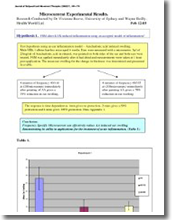
MicrocurrentExperimentalResults
Anti-Inflammatory Effects of Frequency Specific Microcurrent:
Pre-Clinical Research Summary
Reilly WG, Reeve VE, Quinn C, McMakin C
University of Sydney, Faculty of Veterinary Science
Research conducted February 2003 | Presented at Australian Health and Medical Research Congress, 2004
Abstract
Objective: To evaluate the anti-inflammatory and immunomodulatory effects of Frequency Specific Microcurrent (FSM) using validated animal models of inflammation and immune response.
Methods: Male and female SKh-1 albino hairless mice were subjected to arachidonic acid-induced ear edema, UV-induced skin fold edema, and oxazolone contact hypersensitivity protocols. FSM was applied at 200 microamperes using specific frequency combinations. Outcomes were measured using calibrated micrometers with blinded data collection in replication studies.
Results: FSM at frequencies 40/116 Hz and 40/355 Hz produced a 62-70% reduction in lipoxygenase-mediated inflammation within 4 minutes of application (p<0.01). The effect demonstrated frequency specificity—current alone or non-specific frequencies produced no measurable effect. In the UV-induced inflammation model, FSM applied 2 hours post-exposure achieved statistically significant reduction in skin fold thickness (p<0.01). FSM also demonstrated systemic immunomodulatory effects, reducing UV-induced immune suppression from 63.4% to 31.0% when applied immediately post-exposure.
Conclusion: FSM demonstrates significant, frequency-specific anti-inflammatory activity in validated animal models, with effects exceeding those typically observed with pharmaceutical interventions in the same models. These findings support the biological plausibility of FSM’s clinical applications in inflammatory conditions.
Background
Frequency Specific Microcurrent (FSM) is a therapeutic modality that delivers low-level electrical current (typically 200-600 microamperes) at specific frequencies. Clinical observations have suggested anti-inflammatory effects when particular frequency combinations are applied, but controlled experimental validation of these effects had not been performed prior to this research.
The arachidonic acid-induced ear edema model is a well-established assay for evaluating anti-inflammatory compounds. This model specifically activates the lipoxygenase (LOX) pathway, producing measurable ear swelling that can be quantified with precision micrometers. The model has been validated extensively in pharmaceutical research for screening potential anti-inflammatory agents.
This research was designed to test four hypotheses: (1) that FSM alters LOX-induced inflammation in a validated model; (2) that specific frequencies are required for the effect; (3) that FSM affects UV-induced inflammation; and (4) that FSM modulates systemic immune function.
Methods
Animal Model
Male and female SKh-1 albino hairless mice aged 6-8 weeks were used across all experiments. This strain is standard for dermatological and inflammation research due to their hairless phenotype and well-characterized inflammatory responses.
Arachidonic Acid-Induced Ear Edema Protocol
Baseline ear thickness was measured using calibrated calipers. Five microliters of arachidonic acid solution (25 mg/ml in ethanol) was painted on both sides of each ear. FSM was applied immediately after the solution dried, with measurements taken at 1 hour post-application. The change in ear thickness (mean ear swelling) was calculated and compared across treatment groups.
UV-Induced Inflammation Protocol
Female mice were irradiated for 28.95 minutes under a solar-simulated light source, delivering two Minimal Erythemal Doses (MED) of UV radiation. This exposure level produces a measurable sunburn response with peak skin fold thickness at 24 hours. FSM was applied either immediately after UV exposure or at 2 hours post-exposure.
Contact Hypersensitivity Protocol
Following UV exposure experiments, mice were sensitized with oxazolone to evaluate contact hypersensitivity (CHS) responses. This model measures systemic cell-mediated immunity—specifically the ability to mount a Th1 immune response to a chemical sensitizer at a site distant from initial sensitization.
FSM Treatment Parameters
| Parameter | Frequency A (Hz) | Frequency B (Hz) | Duration |
| Anti-inflammatory | 40 | 116 | 4 minutes |
| Anti-inflammatory (alt) | 40 | 355 | 2-4 minutes |
| Sham/Control | 0.1 | 0.1 | 4 minutes |
| Non-specific control | Various | Various | 4 minutes |
Table 1. FSM treatment parameters. All treatments delivered at 200 microamperes.
Current intensity was maintained at 200 microamperes across all experiments. Mice were treated simultaneously using a treatment box modified for FSM application.
Results
Experiment 1: Arachidonic Acid-Induced Inflammation
Four minutes of FSM at frequency 40/116 Hz or 40/355 Hz applied immediately after arachidonic acid produced a 70% reduction in ear swelling compared to untreated controls. The response demonstrated clear time-dependency:
| Treatment Duration | Reduction in Ear Swelling |
| 1 minute | 0% (no protection) |
| 2 minutes | 50% |
| 4 minutes | 62-70% (maximum effect) |
Table 2. Time-dependent response to FSM treatment in the arachidonic acid model.
Experiment 2: Blinded Replication
A blinded replication study using frequency 40/116 Hz confirmed the initial findings. Data collection was performed without knowledge of treatment group assignment. This experiment included a negative control group receiving current (200 microamperes) with no frequency set (0/0).
Results: The 40/116 Hz group demonstrated a 62% reduction in ear swelling compared to both the positive control (arachidonic acid only) and the negative control (current without frequency). Notably, 100% of treated animals responded to the intervention—a response rate not typically observed with pharmaceutical agents in this model.
Experiment 3: Frequency Specificity
To determine whether the observed effects were frequency-specific or simply due to electrical current, additional frequency combinations were tested:
| Treatment Condition | Effect on Ear Swelling |
| 40/116 Hz (anti-inflammatory) | 62-70% reduction |
| 40/355 Hz (anti-inflammatory) | 70% reduction |
| 0.1/0.1 Hz (current only) | No reduction |
| Mineral/Bone frequencies | No reduction |
| Intermediate protocol frequencies | No reduction |
Table 3. Frequency specificity of anti-inflammatory effects. Only specific frequency combinations produced measurable effects.
Conclusion: Current alone produced no anti-inflammatory effect. The therapeutic response required specific frequency combinations, demonstrating that the mechanism of action is frequency-dependent rather than simply a function of electrical stimulation.
Experiment 4: UV-Induced Inflammation
FSM was tested on UV-induced skin fold edema (a model of sunburn response) at two time points: immediately after UV exposure and 2 hours post-exposure. The combined protocol used frequencies 40/116 Hz (4 minutes), 40/355 Hz (2 minutes), and 40/103 Hz (2 minutes).
| Treatment Timing | Skin Fold Reduction | Statistical Significance |
| Immediately post-UV | Partial reduction | p < 0.05 |
| 2 hours post-UV | Significant reduction | p < 0.01 |
Table 4. FSM effects on UV-induced skin fold edema measured at 21-27 hours post-UV exposure.
Experiment 5: Systemic Immunomodulation
Mice from the UV experiment were subsequently sensitized with oxazolone to evaluate FSM’s effect on UV-induced systemic immune suppression. UV radiation is a known suppressor of contact hypersensitivity (CHS) responses—a measure of Th1-mediated immunity.
| Treatment Group | Immune Suppression |
| Non-UV control (baseline) | 0% |
| UV only | 63.4% |
| UV + FSM at 2 hours | 57.5% |
| UV + FSM immediately | 31.0% |
Table 5. Effect of FSM on UV-induced immune suppression as measured by oxazolone CHS response.
FSM applied immediately after UV exposure reduced immune suppression by approximately 50% (from 63.4% to 31.0%), demonstrating a systemic immunomodulatory effect. This finding indicates that FSM can influence Th1 immune responses and supports the development of systemic immunological memory despite UV exposure.
Discussion
Clinical Significance
The magnitude of effect observed in these experiments is noteworthy. The 62-70% reduction in lipoxygenase-mediated inflammation exceeds what is typically achieved with oral anti-inflammatory compounds in this validated model, where reductions of 20-37% are considered significant. The principal investigator, Dr. Vivienne Reeve, noted that in over 18 years of testing compounds in this model, no prescription or non-prescription agent had achieved reductions greater than 45%.
Mechanism of Action
The frequency specificity demonstrated in these experiments suggests that FSM does not work simply through electrical stimulation. Current alone (at 200 microamperes with frequencies set to 0.1/0.1 Hz) produced no measurable effect. Non-specific frequency combinations similarly failed to alter inflammation. This indicates a resonance-based mechanism where specific frequencies interact with biological systems in a targeted manner.
Time-Dependent Response
The clear dose-response relationship with treatment duration (0% at 1 minute, 50% at 2 minutes, maximum effect at 4 minutes) suggests an accumulation of biological effect that plateaus at 4 minutes. This finding has direct clinical implications for treatment protocols—brief exposures may be insufficient to achieve therapeutic benefit.
Response Rate
The 100% response rate observed in treated animals is unusual for pharmacological interventions. In pharmaceutical studies, responder rates are typically variable. The uniform response to FSM suggests a fundamental biological mechanism that may be less susceptible to individual variation than drug metabolism or receptor expression.
Limitations
This research was conducted in a controlled laboratory setting using a single animal model and has not been replicated in independent laboratories. The findings represent pre-clinical evidence that supports the biological plausibility of FSM but should not be extrapolated directly to human clinical applications without appropriate clinical trials.
Conclusions
- FSM at frequencies 40/116 Hz or 40/355 Hz produces greater than 60% reduction in arachidonic acid-induced ear swelling in a validated model of LOX-mediated inflammation.
- The effect is reproducible and maintains statistical significance in blinded data collection.
- Frequency is an absolute requirement—current alone produces no anti-inflammatory effect.
- FSM produces statistically significant reduction in UV-induced inflammation (p<0.01 at 2 hours post-exposure).
- FSM demonstrates systemic immunomodulatory activity, reducing UV-induced immune suppression by approximately 50% when applied immediately post-exposure.
These pre-clinical findings provide mechanistic support for the clinical applications of Frequency Specific Microcurrent in inflammatory conditions and establish the frequency-specific nature of its biological effects.
References
Kim SY, Son KH, Chang HW, Kang SS, Kim HP. Inhibition of mouse ear edema by steroidal and triterpenoid saponins. Arch Pharm Res 1999;22(3):313-6.
Qian C, Hwang SB, Libertine-Garahan L, et al. Anti-inflammatory activities of LDP-392, a dual PAF receptor antagonist and 5-lipoxygenase inhibitor. Pharmacol Res 2001;44(3):213-20.
Ueda H, Yamazaki M. Anti-inflammatory and anti-allergic actions by oral administration of a perilla leaf extract in mice. Biosci Biotechnol Biochem 2001;65(7):1673-5.
Danno K, Ikai K, Imamura S. Anti-inflammatory effects of eicosapentaenoic acid on experimental skin inflammation models. Arch Dermatol Res 1993;285(7):432-5.
Kotyuk B, Raychaudhuri A, DiPasquale G. Effect of anti-inflammatory compounds on edema formation and myeloperoxidase activity in the arachidonic acid-induced ear model in the mouse. Agents Actions 1993;39 Spec No:C46-8.
| Citation
Reilly WG, Reeve VE, Quinn C, McMakin C. Anti-inflammatory effects of interferential frequency-specific applied microcurrent. Proceedings of the Australian Health and Medical Research Congress. Sydney, Australia; February 2004. |
Disclosure: This research was conducted at the University of Sydney in collaboration with Health World Ltd. and has been presented at medical conferences but has not been published in a peer-reviewed journal.